General Concept
A simple harmonic oscillator is a classical system where we think of a ball in a parabolic potential or a mass attached to a spring. We are generally interested in understanding how the objects position changes with time.
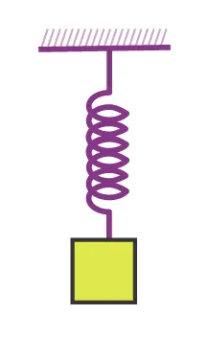
Formulas
Derivation of ODE
The restoring force for a mass on a spring is given by
From here we can write this as a ODE since acceleration is related to position by thus
We can choose the variable so that this becomes
And with appropriate initial conditions we can solve this.
Solution to ODE
Since this is a second order ODE with constant coefficients we can use the Characteristic Equationequation to solve this. In particular the characteristic equation is
Which falls under the complex conjugate case. Thus the solution to this ODE is
Damped Harmonic Oscillator
Now we can consider what happens when the harmonic oscillator is dampened. Newtons equation tells us the ODE will be
Which we can write as
Often this ODE is written is a different way
Where and is called the unitless dampening parameter. The solution to this ODE then depends on the value of this parameter since the characteristic equation becomes
So there are three cases, when and which correspond to under-damped, critically damped, and over-damped. Notice these cases effect whether we are in case 1, 2 or 3 of Characteristic Equation. Writing this in a general form we have
Damped Driven Harmonic Oscillator
We can also apply a driving force to an oscillator so that Newtons law tells us
Although many types of driving can be applied (step function, sinusoidal, square, etc) we will only consider a sinusoidal driving force since this is useful for atomic physics. So our ODE becomes
Where is the amplitude of the driving force and is the driving angular frequency. To solve this we first consider the homogeneous solution, which is nothing but the damped oscillator in the last part.
To find the particular solution we make a guess about the form of the solution. If an oscillator has something sinusoidally driving it then its reasonable to assume the oscillations will follow that driving force, but possibly out of phase. So lets guess the form of the solution is
To check our solutions we plug it into the ODE which gives
Now expanding and we can write
Now both must be equal to zero since cosine and sine are orthogonal thus we can solve for and giving
So the solution is
Thus the full solution is
Where is the homogenous solution which is also called the transient solution.
Lets look at some characteristics of this oscillator. One important point is the amplitude as a function of the driving frequency. Notice that the steady state solution has an amplitude that is the shape of a Lorentzian. This can be seen in this plot
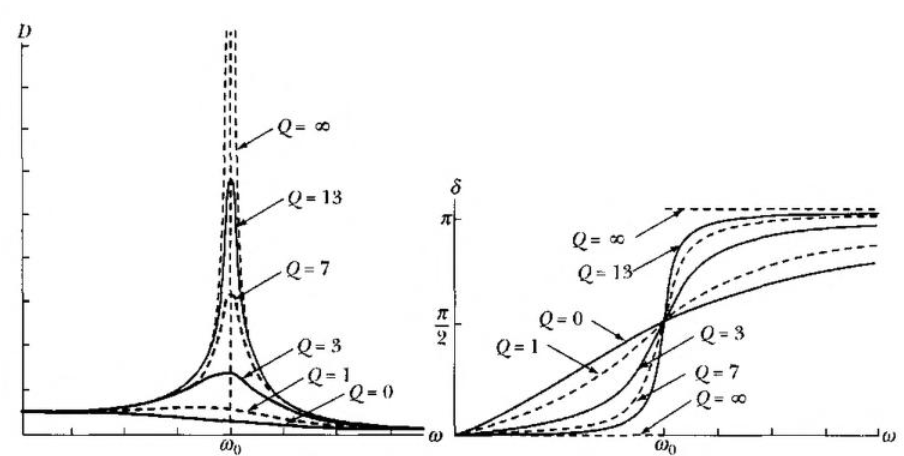
What we see is as we change the detuning we change the amplitude of the steady state oscillation. The being shown here is know as the quality factor of Q factor. It describes how many oscillations you see before they are damped out by the damping term. The Q factor can be calculated
Atomic Physics
With this knowledge of the harmonic oscillator we can use a simple model of an electron bound to a nucleus that oscillates, called the Lorentz model, to understand some of the phenomena seen in the lab.
The damped oscillator tells us if the electron has some initial displacement, oscillations will damp out due to radiation emitted from the acceleration of the charge. The damping time is exactly related to the lifetime seen in the lab. To show this we first write down the damping parameter which comes from the emitted radiation, which is due to the acceleration of the charged particle.
References
Wikipedia Classical Dynamics Marion Metcaf and Vanderstraten Atomic Physics Foot