General Overview
Photoassociation happens when two colliding atoms see resonate light and undergo excitation into a excited molecular potential.
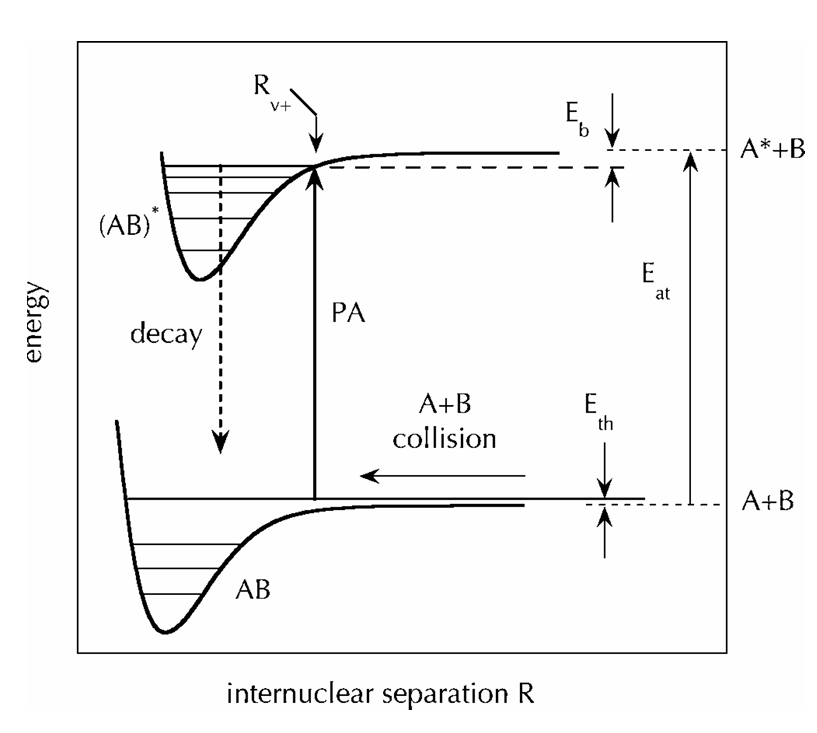
This is most likely to happen at the outer turning point of the excited state potential. This is because the wavefunction in the short range part of the potential oscillates quickly and averages to zero. Where as at the long range part it oscillates more slowly. The probability to transition is given by Frank-Condon factor (the square of the overlap of the two wavefunctions). Thus the largest contribution comes from the last lobe of the excited state wavefunction which occurs at the turning point.
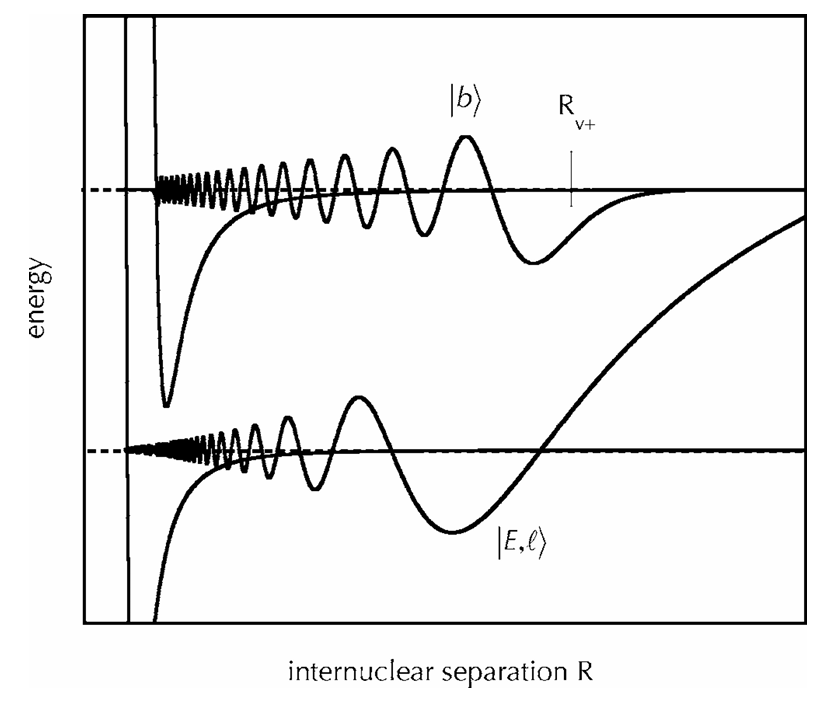
Note that the excited state potentials go as whereas ground state potentials go as
Formulas
Now we know the loss rate for photoassociation is given by
Where
Note that k is the thermal wavevector and is the average velocity in a maxwell Boltzmann distribution
These formula are given by Mohit’s PA Cheat Sheet.